Position #1 Now Sits Halfway Down the Page: What Pixel-SERP Data Means for AI Visibility
By BeRecommended Team
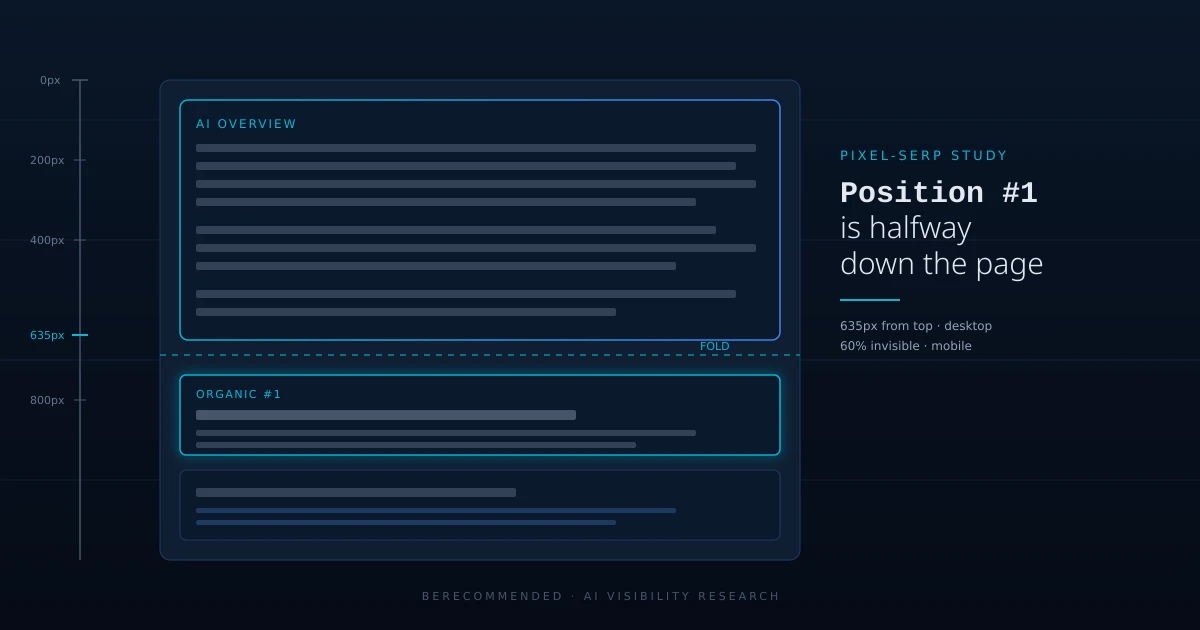
A pixel-SERP study presented by STAT's Tom Capper and recapped by Search Engine Journal on May 29 replaces traditional rank positions with vertical pixel distance. The headline finding: on a typical laptop screen, the median organic position #1 result sits roughly 635 pixels from the top edge. That places it about halfway down an 800-pixel viewport. Nowhere near "top of page" in any visual sense.
On mobile, the numbers are worse. Nearly two-thirds of position #1 organic results are completely invisible on a standard smartphone screen without scrolling. Not just below the fold. Invisible.
TL;DR
Organic #1 on desktop sits at 635px from top, roughly mid-screen on a standard laptop. On mobile, 60-67% of #1 organic results require scrolling to see at all. AI Overviews now consume over 1,200 pixels of vertical space on average, up 15% year-over-year. Rank tracking as a standalone KPI has lost its connection to actual visibility. The real metric is pixel position combined with AI citation presence.
What the Study Found
The study measured SERP results by vertical pixel distance rather than numbered rank positions. Three data points stand out.
Desktop visibility. The median organic #1 result appears at roughly 635 pixels from the top of the page. On a standard 800-pixel laptop viewport, that means position #1 shows up about halfway down the screen. Position #2 is already below the fold more often than not. Only 57% of organic position-one results appear above the fold on desktop.
Mobile visibility. On smartphones, 60-67% of organic #1 results do not appear on screen at all before the user scrolls. As Capper put it during the webinar: "Nearly two-thirds of the time, the number one organic result is not visible at all, not even the first row of text on a typical smartphone."
What replaced organic at the top. On informational queries, AI Overviews alone consume nearly a third of above-the-fold visual space. Combined with Knowledge Graph panels, that figure reaches 41%. On commercial queries, paid ads and shopping units occupy more than 60% of the prime visual area. Organic gets roughly 16%.
AI Overviews have grown to an average height exceeding 1,200 pixels in early 2026, a 15% increase from approximately 1,050 pixels a year earlier. On a 900-pixel desktop viewport, the AI Overview alone extends past the entire visible screen.
Why This Changes the AI Visibility Equation
The core takeaway is structural, not temporary. If organic #1 is no longer at the top of the page, the only "top-of-page" position left is inside the AI Overview itself. That makes AI citation the new above-the-fold placement.
This does not mean rank is irrelevant. Higher-ranked pages are still more likely to be cited by AI Overviews. But rank position alone no longer tells you whether anyone sees your result. A brand holding position #1 across its target keywords might report excellent SEO performance while experiencing declining traffic, declining CTR, and zero AI citations. The rank tracker shows green. The actual visibility picture is red.
The gap between rank and visibility has existed for years. This study puts pixel-level numbers on it for the first time.
Separate data reinforces the pattern. AI Overview frequency surged 58% across nine industries in early 2026, according to ALM Corp research. More queries trigger AI Overviews, each one pushing organic results further down. The fold is not just moving. It is accelerating away from organic.
What Brands Should Do This Week
Start measuring pixel position alongside rank. Tools like seoClarity, DemandSphere, and Rabbit Rank already offer pixel-based SERP tracking. If your current rank tracker reports only numbered positions, you are looking at an incomplete picture.
Audit rich result eligibility for your top commercial keywords. A plain organic listing measures about 120 pixels tall. An organic listing enhanced with images, prices, and ratings runs roughly 240 pixels, double the visual footprint. Prioritize schema markup work by pixel gain potential, not search volume.
Check your AI Overview citation status. For your top 10 brand-relevant queries, search Google and note whether your brand appears in the AI Overview. If the AI Overview occupies the entire above-the-fold space and you are not cited in it, your position #1 organic ranking is generating impressions that almost nobody sees.
Combine pixel position and AI citation into a single visibility metric. Rank trackers show one dimension. AI citation monitors show another. Neither gives the full picture alone. The brands that understand their real search visibility in 2026 are the ones that measure both together.
How to Measure Your Actual Visibility
Run a visibility audit across two dimensions. First, pixel position: for your top 20 keywords, what is the vertical pixel distance from the top of the SERP to your result? Second, AI citation presence: across ChatGPT, Perplexity, Claude, Gemini, and Google AI Overviews, is your brand cited when users ask questions in your category?
BeRecommended scores both dimensions in a single AI Visibility Report, rated 0-100 with per-engine breakdowns. If your rank tracker says you are winning but your traffic says otherwise, the gap between rank and real visibility is the most likely explanation.
FAQ
Is rank tracking still worth doing?
Yes, but not as a standalone KPI. Rank feeds into pixel position calculations and correlates with AI citation probability. Track rank as an input, not as a visibility proxy. Pair it with pixel position data and AI citation monitoring for the actual picture.
Which tools measure pixel-based SERP position?
seoClarity introduced pixel ranking as a metric. DemandSphere and Rabbit Rank offer similar capabilities. STAT (the source of this study) tracks both traditional rank and SERP feature analysis. Most enterprise SEO platforms are adding pixel-level metrics in 2026.
Will AI Overviews keep getting taller?
The trend points that direction. AI Overview height grew 15% year-over-year to over 1,200 pixels average. AI Overview frequency surged 58% across nine industries. Both metrics suggest organic results will continue to be pushed further down the page.
How do I pitch pixel visibility to leadership that only cares about rank?
Show them side-by-side SERPs where rank says #1 but the visual reality shows mid-page placement behind AI Overviews and paid units. Then compare your organic impression volume against other channels. As Capper noted in the webinar: "SEO is an incredible impressions channel" when you measure it correctly.
Sources
- Position 1 Is Halfway Down The Page: New SERP Visibility Data - Search Engine Journal (May 29, 2026) https://www.searchenginejournal.com/updated-serps-new-study-measures-the-serp-in-pixels-not-ranks-recap/577359/
- Google SERP Shifts Reduce Organic Visibility, SEOs Adapt - Rabbit Rank (May 29, 2026) https://rabbitrank.com/blog/google-serp-layout-shift-pixels-not-rank-matter
- Google AI Overviews Surge Across 9 Industries - ALM Corp (2026) https://almcorp.com/blog/google-ai-overviews-surge-9-industries/
- What Is Pixel Ranking - seoClarity (2026) https://www.seoclarity.net/blog/what-is-pixel-ranking
Stay ahead of the AI curve
Get weekly insights on AI visibility, search optimization, and brand strategy — straight to your inbox.