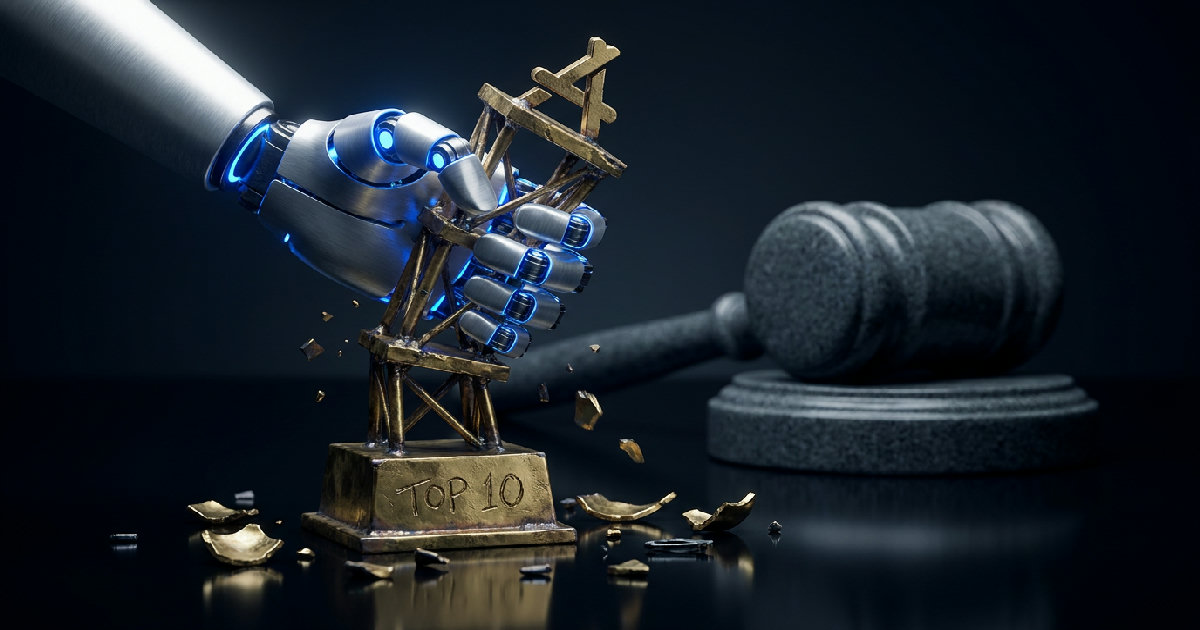
Google AI Overviews Just Killed the Self-Ranking Listicle. Here's What to Do Instead.
By Jakub
Google's AI Overviews stopped trusting your "Top 10" list where you put yourself at #1. Lily Ray at Amsive documented the fallout: 30% to 50% organic visibility drops, concentrated in blog and guide subfolders. If your Q2 content plan includes a self-ranking listicle, it's probably dead on arrival.
Here's what changed, why Google did it, and five things you can do instead.
TL;DR
Google AI Overviews no longer cites self-published "best of" listicles where the publisher ranks themselves first. Amsive (Lily Ray) reports 30-50% visibility drops. Gemini citations for "best of" listicles fell 40% in April 2026. The fix: get mentioned by third parties, not by yourself.
What Actually Changed
Barry Schwartz covered it in his May 13 Search Engine Roundtable recap. The core shift: Google AI Overviews now deprioritizes self-promotional listicle content when answering "best X" queries.
Before this change, the playbook was simple. Publish a "Top 10 CRM Tools for Small Business" article on your own blog. Put your product at #1. Google's AI Overview would pick it up and cite your brand as a recommendation. Every GEO/AEO pitch deck in 2024-2025 had some version of this tactic.
That stopped working in May 2026.
Amsive's data tells the story clearly. Websites relying on self-ranking listicles saw 30% to 50% drops in organic visibility. The losses hit blog, guide, and tutorial subfolders hardest. That's exactly where most "top 10" content marketing lives.
Parallel signal from Gemini: "best of" listicle citations dropped 40% in April 2026. This isn't one platform quirking out. It's a cross-engine trend.
Google's January 2026 enforcement against self-promotional listicles (confirmed by Jennifer Kutz and reported in The Verge, April 2026) set the stage. Some sites saw up to 49% visibility loss after that enforcement alone.
Why Google Did This
Three forces converged.
First, trust degradation. When every SaaS company publishes a "best CRM" article ranking themselves #1, the signal becomes noise. Google's quality raters have flagged self-promotional content for years. AI Overviews just made the penalty automatic.
Second, Google rolled out community and discussion insights in AI Overviews in early May 2026. TechCrunch reported on May 6 that Google is actively pushing Reddit and web forum content into AI answers. Real user opinions now outrank corporate self-promotion.
Third, Google started highlighting content from subscribed publications (Nieman Lab, May 6, 2026). Editorial credibility gets priority over self-published marketing content.
All three point the same direction: don't give yourself the mic. Earn it from someone else.
Who's Getting Hit Right Now
Three patterns keep showing up in the data.
B2B SaaS "best of" publishers. The company blog post titled "7 Best Project Management Tools (We're #1)" used to drive real visibility. Now it's a liability. These teams built entire content calendars around comparison articles where they always win.
E-commerce affiliate-style listings. Product review sites that rank their own inventory highest. The "best running shoes" article written by the shoe store. Google's AI now skips these in favor of independent reviewers and forum discussions.
Review sites with self-promotional bias. Software directories that weight their own ratings above aggregated user scores. If your "methodology" consistently ranks your paying customers first, AI Overviews noticed.
Key Takeaways: Five Alternatives That Still Work
Get placed in third-party listicles. Instead of publishing your own "Top 10" article, invest in PR to get included in listicles published by industry publications, analyst firms, and independent reviewers. A mention in a TechCrunch or G2 roundup carries more weight in AI answers than ten self-published comparisons.
Build a Reddit and forum footprint. YouTube recently became the #1 AI citation source, but Reddit isn't far behind. The play here is entity strategy, not keyword stuffing. Real users mentioning your brand in relevant threads creates the kind of signal AI engines trust. Participate in communities where your customers already talk.
Invest in YouTube content. Video content now drives more AI citations than any other format. Product demos, honest comparisons (where you acknowledge competitors' strengths), and tutorial content all build the kind of authority that self-ranking listicles used to fake.
Build your review platform presence. G2, Capterra, Trustpilot. Mentions on established review platforms get weighted higher in AI answers. A structured review pipeline that encourages real customer feedback creates durable citation signals.
Publish original research, not original rankings. Run a benchmark study. Survey your user base. Publish data that other publications will cite. "Our analysis of 500 AI search results found X" is cite-worthy. "Our product is the best because we said so" is not.
Measure Before You Rewrite Your Content Calendar
Before you panic-delete every listicle on your blog, check what's actually happening. Not all listicles are dead. Memorable Design's counter-analysis shows listicles as a format still hold 21.9% of AI citation share. The key distinction: third-party listicles (written by independent publishers about a category) still work fine. Self-ranking listicles (written by a competitor in that category about themselves) are what Google killed.
The question isn't "do listicles work?" It's "who wrote it, and did they rank themselves #1?"
If you're a brand manager trying to figure out which third-party sources your brand is missing from in AI answers, that's exactly what Be Recommended does. Find the gaps, fix the sources, track the citations.
FAQ
Are all listicles dead for AI search?
No. Third-party listicles written by independent publications still get cited. What died is the self-published listicle where the author ranks their own product first. The format works. The self-promotion doesn't.
How fast will this affect my traffic?
Amsive's data shows 30-50% drops happening within weeks of the change. If your organic traffic relies heavily on "best X" comparison content where you feature yourself, check your analytics now.
Does this apply to Perplexity and ChatGPT too?
The Amsive data specifically covers Google AI Overviews and Gemini. Perplexity and ChatGPT have their own citation logic, but the trend toward third-party credibility applies across all AI search engines.
What should I do with existing self-ranking listicles?
Don't delete them. They may still rank in traditional search. But don't expect them to drive AI citations. Redirect your content budget toward earning third-party mentions instead.
Sources
- Barry Schwartz, Search Engine Roundtable Daily Recap, May 13, 2026
- Lily Ray, Amsive, analysis of self-ranking listicle visibility drops (cited in SE Roundtable)
- TechCrunch, "Google updates AI search to include expert advice from Reddit and other web forums," May 6, 2026
- Nieman Lab, "Google highlights links from subscribed publications in new AI Overviews update," May 6, 2026
- Sword and the Script, "The end of the self-aggrandizing listicle," February 2026
- Memorable Design, "Listicle SEO 2026," counter-analysis showing 21.9% AI citation share for listicle format
Stay ahead of the AI curve
Get weekly insights on AI visibility, search optimization, and brand strategy — straight to your inbox.