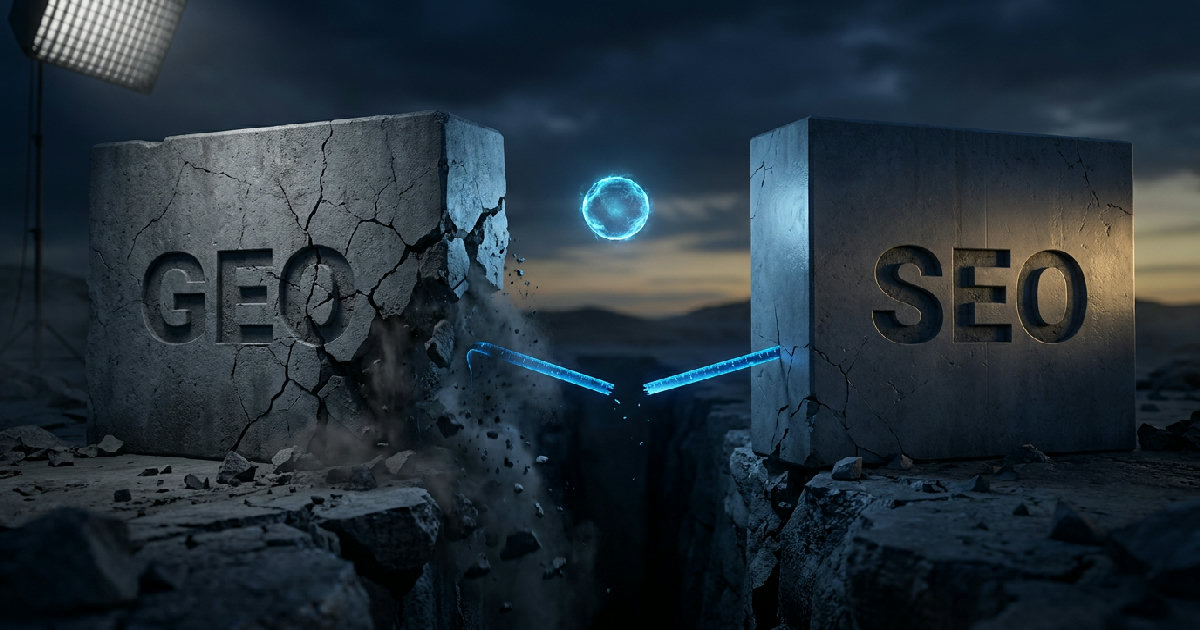
GEO vs SEO Budget Split: The 2026 Data That Changes Everything
By Jakub
TL;DR
The overlap between top Google rankings and sources cited in AI-generated answers has collapsed from 70% to under 20%, according to Brandlight analysis cited in 5WPR's latest GEO Practice Guide. Ranking #1 on Google no longer means ChatGPT, Claude, or Perplexity will mention your brand. SEO and GEO now require separate budgets, separate tactics, and separate KPIs. This article gives you the budget-split framework and five data points to defend the reallocation at your next board meeting.
Key Takeaways
- 70% to under 20% — the share of top-ranking Google pages that are also cited in AI answers, per Brandlight
- 13 weeks — the AI citation freshness decay threshold; content older than one quarter loses citation velocity
- 3 to 5 days vs 3 to 6 months — how fast new content enters the AI citation pool compared to Google's organic index
- 5 operational dimensions where GEO diverges from SEO: tone, format, freshness, measurement, and the click
- Budget-split guidance by company stage: early-stage 70/30 GEO-to-SEO, mid-market 40-50% shift, enterprise 15-25% start scaling to 30-40% within 12 months
The Overlap That Broke
For years, the working assumption was simple: optimize for Google, and AI engines will follow. When 70% of AI-cited sources also ranked in Google's top results, that assumption held. You could run one playbook and cover both channels.
That era is over. 5WPR published the tenth installment of their GEO Practice Guide series on May 4, 2026, titled "GEO vs. SEO: The 2026 Venn Diagram." The centerpiece finding comes from Brandlight's analysis: the overlap between pages ranking in Google's top positions and pages cited inside AI-generated answers has dropped below 20%.
The implication is blunt. Four out of five pages that AI engines cite when answering user questions do not rank in Google's top results. And four out of five pages that rank #1 on Google are invisible inside ChatGPT, Claude, Gemini, and Perplexity answers. The signals have diverged.
Five Dimensions Where GEO Splits From SEO
5WPR's report identifies five operational dimensions where the two channels now require fundamentally different approaches.
- Tone — Google rewards persuasive, conversion-oriented copy. AI engines favor neutral, factual, definition-first language that they can safely quote in an answer.
- Format — Listicles, comparison tables, FAQ blocks, and definition-first sentences perform in AI citations. Long-form narrative SEO content does not extract well.
- Freshness — AI citation velocity decays after roughly 13 weeks. Content older than one quarter drops out of the active citation pool. Google's freshness signal is far more forgiving.
- Measurement — GA4 does not track AI-referred traffic by default. Manual configuration is required to separate AI-origin sessions from organic search.
- The click — In SEO, the click is the KPI. In GEO, citation without a click is still a visibility unit. Brands mentioned inside an AI answer reach the user even if no one clicks through.
The 13-Week Refresh Cycle
The freshness decay threshold deserves its own operating model. If AI engines deprioritize content older than 13 weeks, your content roadmap needs a quarterly refresh cycle built in.
That means every pillar page, every core product explainer, and every competitive comparison should be revisited four times per year. Not rewritten from scratch, but updated with new data points, fresh dates, and current examples. The update signal matters more than the rewrite scope.
This also explains why newsjacking works disproportionately well in GEO. New content enters the AI citation pool in 3 to 5 days, compared to 3 to 6 months for Google's organic index. A brand that publishes a timely take on breaking industry data can appear in AI answers within a week, while traditional SEO would take half a year to deliver the same visibility.
Budget-Split Framework by Company Stage
5WPR's report includes a budget-split framework calibrated to company maturity.
- Early-stage companies — 70% GEO, 30% SEO. When you have no existing search equity, investing heavily in traditional SEO means waiting 6+ months for results that may never compound. GEO delivers measurable citation velocity in weeks.
- Mid-market companies (50-500 employees) — shift 40-50% of existing SEO budget into GEO. You already have search equity worth protecting, but the citation gap is growing every quarter you delay.
- Large enterprises — start at 15-25% GEO allocation and scale to 30-40% within 12 months. Enterprise SEO programs have deep moats. The risk is not that SEO stops working overnight. The risk is that the AI citation gap compounds silently while the board only watches Google rankings.
The CMO Board Defense Checklist
If you need to justify this reallocation to a CFO or board, here are five data points that fit on one slide.
- Brandlight overlap collapse: 70% to under 20%. The one-playbook era is mathematically over.
- Gartner's 2026 forecast: 25% decline in organic search traffic to commercial sites. The SEO pie is shrinking.
- Similarweb zero-click data: 65% of searches now end without a click. Even in SEO, the click is becoming the exception.
- AI citation entry speed: 3-5 days for GEO vs 3-6 months for SEO. Dollar-for-dollar, GEO delivers faster visibility.
- 13-week decay threshold: content refresh cycles must match AI freshness signals, not Google's annual crawl patterns.
Where to Start: Measure Your Current AI Visibility
Before reallocating budget, you need a baseline. Ask the five AI engines (ChatGPT, Claude, Gemini, Perplexity, Copilot) your top 10 customer questions and count how often your brand appears in the answers. That number is your current AI citation share.
BeRecommended runs this diagnostic automatically. You get your citation share, the gap to your competitors, and the specific content and structural changes that would close it. The audit takes minutes and gives you the baseline numbers for your board slide.
FAQ
Does SEO still matter if AI citations are diverging?
Yes. SEO drives direct traffic and conversions. The point is not to abandon SEO but to stop assuming it covers AI visibility. They are now separate channels requiring separate investment.
How do I track AI-referred traffic in GA4?
GA4 does not separate AI-origin visits by default. You need to configure custom channel groupings that identify referrals from chat.openai.com, perplexity.ai, gemini.google.com, and similar AI domains.
What is the minimum GEO budget for a startup?
There is no fixed floor. The 5WPR framework suggests 70% of your combined search visibility budget. For a bootstrapped startup spending $2,000/month on content, that means $1,400 on GEO-optimized content and $600 on technical SEO fundamentals.
How often should I refresh content for AI citation freshness?
Every 13 weeks, per the Brandlight decay threshold. Build a quarterly content refresh into your editorial calendar alongside new content production.
Sources
- 5WPR GEO Practice Guide, Part 10: GEO vs. SEO: The 2026 Venn Diagram (May 4, 2026)
- 5WPR PR Newswire announcement (May 4, 2026)
- Brandlight — AI citation overlap analysis
- Gartner 2026 prediction: 25% decline in organic search traffic to commercial sites
- Similarweb zero-click study (2024): 65% of searches end without a click
Related Reading
Stay ahead of the AI curve
Get weekly insights on AI visibility, search optimization, and brand strategy — straight to your inbox.