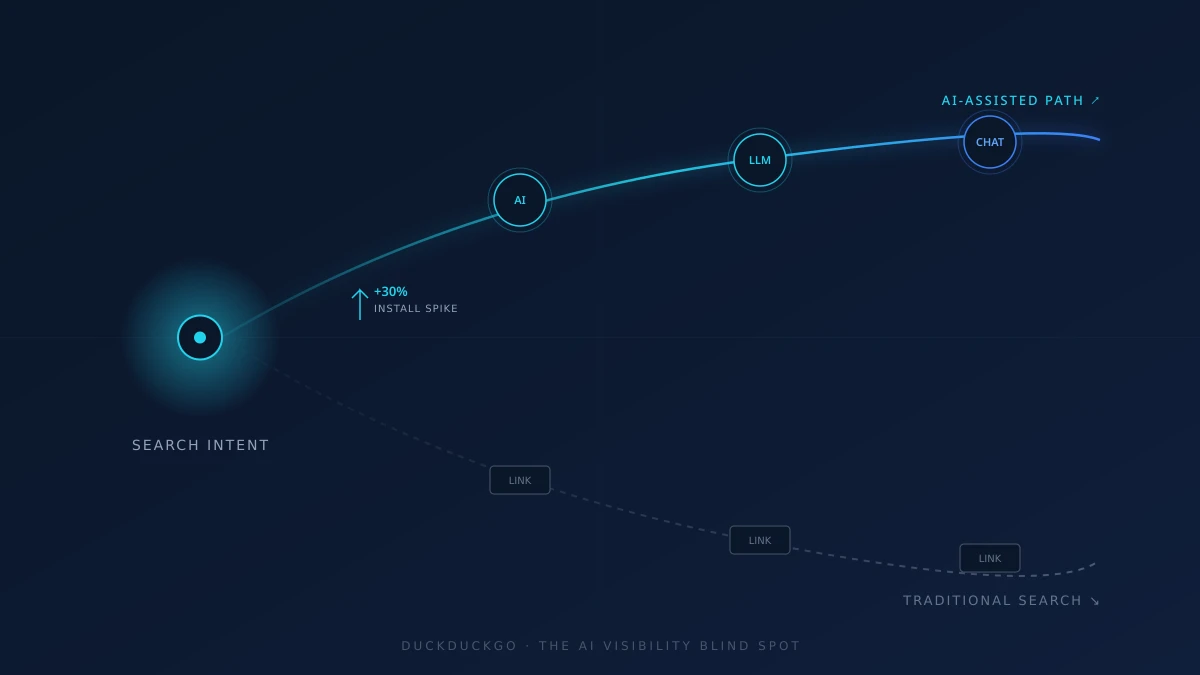
DuckDuckGo's 30% Install Spike Reveals a Blind Spot in Every AI Visibility Strategy
By BeRecommended Team
DuckDuckGo just recorded its highest weekly install growth in company history. Between May 20 and 25, US app installs climbed 18.1% week-over-week on average, peaking at 30.5% on May 25. iOS growth hit 33% average, with a single-day peak of 69.9%. The trigger: Google's I/O 2026 announcements replaced traditional blue links with AI agents, and a significant chunk of the search audience walked.
Most coverage frames this as "users reject AI search." The data tells a more nuanced story, one that changes how brands should think about AI visibility measurement.
What happened
Google announced three major shifts at I/O 2026 on May 19: AI Mode expansion to over one billion monthly users, the May 2026 Core Update (rolling out from May 21), and Preferred Sources integration into AI Overviews (May 27). Together, these changes made AI the default search experience for most queries.
DuckDuckGo CEO Gabriel Weinberg told TechCrunch that "Google is force-feeding AI with no way to opt out." The install numbers support that claim. The company's AI-free search page at noai.duckduckgo.com saw 22.7% week-over-week average growth, peaking at 27.7% on May 24. The trend was strongest in the US and continued through Memorial Day weekend, when DuckDuckGo normally sees a traffic dip.
The data point most coverage missed: Duck.ai, DuckDuckGo's own AI search product (supporting Claude 4.5 Haiku, Llama 4 Scout, Mistral Small 3, and GPT-5 mini), grew at the same time. Chief Communications Officer Kamyl Bazbaz confirmed: "People just want a choice." Users who switched are not anti-AI. They are anti-default-AI-without-control.
Why this matters for AI visibility
Every GEO playbook published in the past 12 months rests on the same assumption: AI search surfaces are monotonically growing channels, and brand visibility equals share-of-citation across ChatGPT, Perplexity, Gemini, and Google AI Overviews. DuckDuckGo's numbers put a crack in that assumption.
Context first: DuckDuckGo holds roughly 2% of US search market share versus Google's 90%. A 30% spike on a small base creates fewer absolute users than a 5% expansion of Google AI Mode. Brands in mass-market B2C with low-consideration purchases will feel almost no impact from this shift.
For brands selling considered purchases (B2B SaaS, financial services, health tech, professional services), the math changes. DuckDuckGo's early adopters historically show 4x higher DAU/MAU ratios than the average search app user. If 20% of your target audience migrates to non-AI surfaces and your visibility strategy sits entirely inside AI answer engines, you are losing the highest-value segment without knowing it.
From what we have measured across hundreds of AI visibility audits at BeRecommended, most brands today have 85-95% of their organic search visibility concentrated on AI-adjacent surfaces. That was fine when the audience moved in one direction. DuckDuckGo's growth signals the beginning of a two-track search audience.
We call this metric AI Search Concentration Risk. It measures the percentage of your organic reach that depends exclusively on AI surfaces. A brand with 95% concentration and zero presence on DuckDuckGo, Bing classic results, or direct-traffic channels has a structurally fragile visibility profile. Not because AI search is failing, but because the audience is no longer a monolith.
What brands should do now
Five moves, ordered by speed of execution.
Calculate your AI concentration split. In GA4, break down organic traffic by source: Google (with and without AI referral parameters), Bing, DuckDuckGo, direct, social, and referral. If more than 90% comes from AI-adjacent surfaces, you have a concentration risk worth addressing.
Optimize for DuckDuckGo and Bing classic results. These engines weight traditional ranking signals more heavily than AI citation patterns. Submit your sitemap to Bing Webmaster Tools. Check your brand SERP on both engines for your own name. If your brand does not appear in DuckDuckGo results for its own name, that is your first fix.
Build a direct traffic acquisition floor. Email newsletters, branded URL recall campaigns, and social profiles that drive clicks (not just impressions) create traffic independent of any search engine. This is your Non-AI Visibility Floor: the minimum organic presence that survives regardless of how AI surfaces evolve.
Audit your Reddit and forum presence. The AI-skeptic audience over-indexes on Reddit, Hacker News, and vertical forums. These surfaces also drive considered-purchase decisions through peer recommendations rather than AI answers.
Keep investing in AI visibility. This is not a pivot away from GEO. AI search remains the dominant and growing channel for most queries. The move is from a 100% AI-focused strategy to a balanced 85/15 split between AI and non-AI organic investment. Brands that tracked Google's Preferred Sources expansion last week already understand how fast AI surfaces evolve. Apply the same discipline to the non-AI layer.
How to measure impact
Track three dimensions monthly.
AI Concentration Ratio. Percentage of organic traffic from AI-adjacent surfaces versus non-AI surfaces. A healthy target for considered-purchase brands: 70-80% AI, 20-30% non-AI. Mass-market B2C can tolerate higher concentration.
Non-AI citation share. How often your brand appears in DuckDuckGo results, Bing classic results, and Reddit threads for your top 20 keywords. If this number is zero, your Non-AI Visibility Floor does not exist yet.
AI visibility score trend. Keep measuring your presence across ChatGPT, Perplexity, Claude, Gemini, and Google AI Overviews with tools like BeRecommended. The goal: add a non-AI layer without losing ground on AI.
DuckDuckGo's 30% growth marks the first measurable signal that the search audience is splitting. Brand visibility strategies that ignore the split will gradually lose their highest-value users.
FAQ
Is DuckDuckGo's growth a real threat to AI search? No. At roughly 2% US market share, this is audience fragmentation, not a collapse. Brands should diversify, not pivot.
What is AI Search Concentration Risk? The percentage of your organic visibility that depends on AI-powered surfaces. Above 90% means structural exposure to platform changes or continued audience fragmentation.
Should brands stop optimizing for ChatGPT and Perplexity? No. AI surfaces still carry the majority of search traffic. Layer a non-AI visibility effort (15-30% of organic investment) alongside your existing AI optimization.
How do I check my brand's DuckDuckGo visibility right now? Search your brand name and top 10 keywords on duckduckgo.com. It uses Bing's index, so submit your sitemap via Bing Webmaster Tools.
Sources
- TechCrunch: DuckDuckGo installs are up 30% as users reject being 'force-fed' Google's AI Search (May 26, 2026)
- MacRumors: DuckDuckGo's 'No AI' Search Traffic Climbs as Users Reject Google's AI Overhaul (May 29, 2026)
- WinBuzzer: DuckDuckGo Traffic Jumps After Google Doubles Down on AI (May 30, 2026)
- Cybernews: DuckDuckGo enjoys 30% spike after users rebel against being 'force fed' AI by Google
- PikaSEO: DuckDuckGo Hits Record Users in May 2026
Stay ahead of the AI curve
Get weekly insights on AI visibility, search optimization, and brand strategy — straight to your inbox.