CNN Sues Perplexity: What the Publisher Licensing Split Means for Brand Citations
By BeRecommended Team
CNN filed a federal lawsuit against Perplexity on May 28, 2026, alleging the AI search company copied over 17,000 stories, photos, and videos. This is the first AI copyright action by a television network. For brands tracking AI visibility, the lawsuit itself is not the headline. The real shift is structural: Perplexity's source mix is splitting into licensed and blocked tiers, and brand citation paths are splitting with it.
TL;DR
CNN's lawsuit against Perplexity accelerates a two-tier publisher system in AI search: licensed sources (TIME, Gannett, Le Monde, Der Spiegel) vs. blocked sources (CNN, NYT, News Corp, Chicago Tribune, Britannica, Yomiuri Shimbun). Brand visibility in Perplexity is increasingly a function of which publishers Perplexity can legally access, not content quality alone. Brands whose AI citations depend on blocked publishers face sudden visibility drops with no warning.
What Happened
CNN filed suit in the Southern District of New York, alleging Perplexity scraped 17,000+ pieces of CNN content through its PerplexityBot and Perplexity-User crawlers to feed its AI search index. CNN tried to negotiate a licensing deal last year, failed to reach terms, and blocked Perplexity's crawlers. The lawsuit also includes a trademark claim: Perplexity's Comet Plus tier advertised access to CNN premium content despite having no active relationship with CNN.
Perplexity's chief communications officer Jesse Dwyer responded bluntly: "You can't copyright facts."
This adds CNN to a litigation list that now includes News Corp, The New York Times, Chicago Tribune, Encyclopedia Britannica, and Japan's Yomiuri Shimbun. On the other side, TIME, Gannett (with 200+ USA TODAY Network local publications), Le Monde, and Der Spiegel have signed licensing deals through the Perplexity Publisher Program. Gannett's deal includes revenue sharing and analytics access.
The timing compounds the impact. Perplexity's Comet browser hit #3 on the US App Store within 48 hours of its iOS launch in March. Samsung's Galaxy S26 ships with Perplexity integrated at the platform level: Bixby uses Perplexity for web search, Samsung Internet supports it as a default search option. Distribution is scaling faster than at any point in Perplexity's history, and its source mix is restructuring at the same time.
Why It Matters for AI Visibility
Until this wave of lawsuits, brand visibility in AI search was primarily a content quality question. Write authoritative content, get cited by trusted publications, those publications get indexed by AI engines, your brand surfaces in answers. The pipeline was linear.
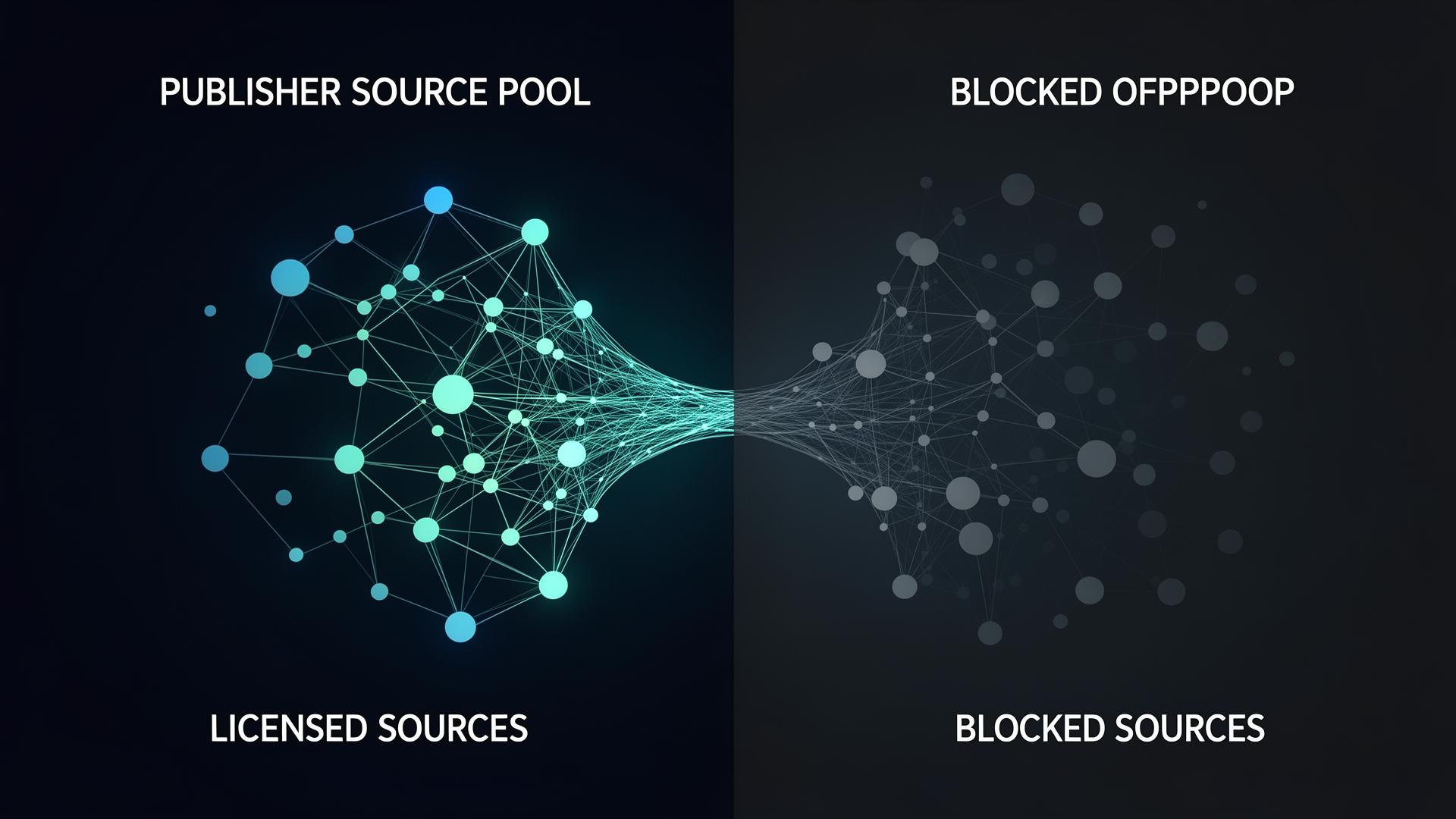
That model is fracturing. Perplexity's source pool is now splitting along contract lines, not quality lines. TIME is in the licensed tier; its content feeds Perplexity answers directly. CNN is in the blocked tier; its content is being removed from the pipeline. Both are high-authority news sources. The differentiator is legal status, not editorial quality.
For brands, this creates a dependency most teams have never tracked. If your brand's Perplexity citations primarily flow through CNN coverage (a feature article, a product review, an executive quote), those citation paths are at risk. When CNN blocks Perplexity's crawlers and the engine removes CNN content from its index, every brand mention that lived in CNN articles goes with it.
This mirrors the pattern we analyzed with Google's Subscribed label: citation surfaces are stratifying based on publisher-platform relationships, not content relevance alone. Google badges subscribed sources with higher click-through rates; Perplexity removes blocked sources entirely. Different mechanisms, same directional shift.
From what we track across AI platforms, the scale of this shift is no longer theoretical. Comet is on iOS. Samsung Internet runs on hundreds of millions of devices. Perplexity's source mix decisions now affect mainstream brand visibility, not just early-adopter queries.
Citation accuracy research from Tow Center showed Perplexity had accuracy issues in 37% of news responses. Licensing is one path to improving accuracy through verified sources. But it also makes coverage patchy: comprehensive on licensed publishers, absent on blocked ones. Brands caught in the gap lose visibility through no fault of their own.
What Brands Should Do Now
Map your citation source mix in Perplexity. Run your top 10 brand queries through Perplexity and document which publishers appear in citations. Cross-reference against the licensed vs. blocked list. If 30%+ of your citations flow through blocked publishers, you have exposure that needs immediate attention.
Track the publisher-engine matrix across platforms. Each AI engine has a different publisher relationship map. ChatGPT has licensing deals that Perplexity does not, and vice versa. Google AI Overviews pull from its search index with subscription-tier differentiation. Your brand visibility profile is now engine-specific, not universal.
Build engine-neutral citation pathways. Wikipedia, Reddit, and your own domain are not subject to publisher licensing disputes. Research on ChatGPT citation patterns shows Wikipedia drives a significant share of citations across engines. Investing in Wikipedia presence, active Reddit participation, and own-domain depth (FAQ pages, comparison guides, glossary entries) hedges against publisher-level disruptions you cannot control.
Increase own-domain content for high-value queries. When an AI engine loses access to a blocked publisher for your brand query, it looks for alternatives. If your own website has structured, authoritative content answering that query, the engine cites you directly. Own-domain visibility is the only citation path fully in your hands.
Set a weekly monitoring cadence. Each new lawsuit or licensing deal changes the source mix. CNN's lawsuit landed two days ago; the next filing could come next week. Quarterly audits are too slow for this environment.
How to Measure Impact
Start with a baseline. Run your core brand queries through Perplexity today and log which domains appear in citations. Classify each as licensed (TIME, Gannett, Le Monde, Der Spiegel), blocked (CNN, NYT, News Corp, Chicago Tribune, Britannica), or neutral (Wikipedia, Reddit, own domain).
Repeat at 7, 30, and 90 days. Track the percentage shift in source composition. If blocked-tier sources drop from your citation mix, check whether replacement sources still mention your brand or whether coverage simply vanishes.
Compare across engines. The same query in ChatGPT, Perplexity, and Google AI Mode returns different source mixes because each engine has different publisher relationships. BeRecommended audits cover this cross-engine comparison, scoring your visibility across ChatGPT, Perplexity, Claude, and Google AI so you can identify where publisher contracts create gaps before they cost you traffic.
The publisher-engine matrix is a new variable in AI visibility. Brands that build tracking infrastructure for it now will see their exposure before the next lawsuit reshapes the landscape.
FAQ
Does CNN blocking Perplexity affect my brand's visibility right now?
It depends on how much of your Perplexity citation profile flows through CNN content. If CNN was a primary source for your brand mentions in Perplexity answers, the effect is direct. Run your top queries through Perplexity to check current source attribution.
Which publishers are currently licensed by Perplexity?
As of May 2026, the Perplexity Publisher Program includes TIME, Gannett (USA TODAY + 200 local publications), Le Monde, and Der Spiegel. The program includes revenue sharing and access to Perplexity's analytics dashboard.
Is this similar to Google's Subscribed label?
Different mechanism, same direction. Google's Subscribed label adds a visual badge to citations from publications users pay for, boosting click-through. Perplexity's split is more binary: licensed publishers stay in the source pool, blocked publishers get removed. Both make publisher-platform relationships a factor in brand citation distribution.
What if most of my AI citations come through blocked publishers?
Diversify toward engine-neutral sources: Wikipedia, Reddit, your own domain's FAQ and comparison pages. Increase own-domain content depth on queries where you relied on publisher coverage. Monitor weekly, because every new deal or lawsuit changes the map.
Sources
Stay ahead of the AI curve
Get weekly insights on AI visibility, search optimization, and brand strategy — straight to your inbox.