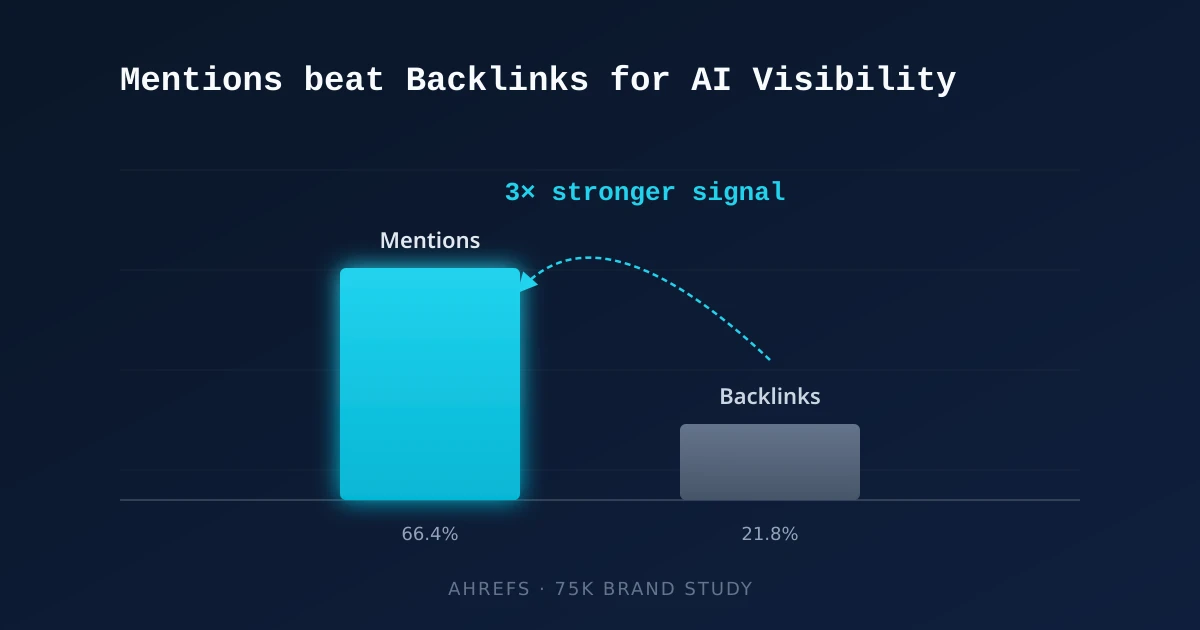
Ahrefs Studied 75,000 Brands: Mentions Beat Backlinks 3 to 1 for AI Visibility
By Jakub
TL;DR
Brand web mentions correlate with AI Overview visibility at 0.664 (Spearman), while backlinks sit at 0.218. That is a 3x gap. Ahrefs Q1 2026 AI Search Benchmark confirmed YouTube mentions as the strongest individual platform signal across 146 million search pages and 730,000 AI responses. Most marketing teams still spend 70-80% of off-page budget on link acquisition. The data says that money is pointed at the weaker signal.
What Happened
Ahrefs published two data studies in the past year that challenge the standard GEO playbook.
The first, a 75,000-brand correlation analysis, measured which search factors align with brand mentions in AI Overviews. Brand web mentions (linked and unlinked) showed a Spearman correlation of 0.664 with AI Overview visibility. Traditional backlinks correlated at just 0.218. The top three correlating factors were all off-site text signals: web mentions (0.664), branded anchors (0.527), and branded search volume (0.392).
The second, a Q1 2026 AI Search Benchmark Report released May 26, expanded the dataset across 146 million search result pages and 730,000 AI responses. YouTube mentions (brand name appearances in video titles, transcripts, and descriptions) emerged as the strongest individual platform signal.
Brands in the top quartile for web mentions averaged 169 AI Overview mentions. The next quartile down averaged 14. Brands in the bottom half averaged 0 to 3. The gap is not incremental.
Why It Matters for AI Visibility
This data reframes GEO from a content optimization problem to a distribution architecture problem.
The standard playbook still assumes the funnel runs: publish on-page content, build backlinks, earn authority, get cited by AI. Ahrefs data shows that pipeline is empirically 3x weaker than the mention-driven alternative. LLMs derive brand authority from text frequency across their training corpus, not from hyperlink graphs. A brand mentioned 200 times across YouTube transcripts, Reddit threads, and podcast show notes registers differently to a language model than a brand with 200 backlinks from mid-tier directories.
We tracked a version of this shift in our own citation source analysis across 1,600 citations from four AI engines. YouTube's share doubled to 24% of all citations; Reddit dropped to 18%. YouTube now outranks Reddit as the single most-cited domain type across ChatGPT, Perplexity, Gemini, and Google AI Mode.
The math compounds fast. Seer Interactive's independent research found backlinks correlated at just 0.10 with ChatGPT brand mentions. Kevin Indig measured brand search volume at 0.334 correlation with ChatGPT visibility. Multiple datasets from different teams point the same direction: text-based brand signals outperform link-based signals for AI citation.
For most marketing teams, this creates a measurable budget misallocation. The typical brand spends 70-80% of off-page budget on link acquisition and 5-15% on PR, creator outreach, and community mentions. The Ahrefs data suggests the allocation should be closer to inverted.
One important caveat: correlation is not causation. Brands with strong YouTube presence typically also have broader brand authority, larger PR footprints, and higher organic traffic. YouTube mentions may function partly as a proxy for overall brand strength rather than a direct driver. For early-stage brands with budgets under $50K per quarter, creator outreach payback runs 4-6 months before AI visibility effects materialize.
What Brands Should Do Now
Audit your mention distribution. Map where your brand name appears across five citation surfaces: YouTube (transcripts, titles, descriptions), Reddit (comments, posts), Wikipedia (article text, references), podcasts (transcripts, show notes), and industry publications. If more than 70% of your brand mentions live on your own domain, you have concentration risk.
Reallocate off-page spend toward mention acquisition. A practical starting ratio: 40% video and creator mentions, 30% PR and earned media, 30% traditional link building. Links still matter for traditional SERP ranking and domain authority. The shift is about where the marginal dollar generates the highest AI visibility return.
Build a YouTube mention pipeline. Three approaches that scale: (1) Industry creator outreach with product seeding, targeting 15-20 YouTube educators in your vertical. (2) Podcast guesting with intentional brand mentions in 3+ episodes per month. (3) Short-form video from your team that consistently names the brand in the first 10 seconds, feeding AI transcript indexing.
Diversify across citation surfaces, not just volume. Ahrefs found brands with both web mentions and AI Overview citations had 40% higher probability of re-citation across AI responses. But only 28% of brands had both. A brand with mentions spread across YouTube, Reddit, Wikipedia, and podcast directories is structurally harder for AI engines to overlook than one mentioned 500 times on its own blog.
How to Measure Impact
Track three metrics on a 30/60/90-day cadence.
Mention Distribution Index. Count your brand mentions across five surfaces (YouTube, Reddit, Wikipedia, podcasts, news outlets) and calculate the percentage per channel. A healthy distribution looks like 25-30% on one dominant surface with 15-20% spread across three others. A 90/10 split signals concentration risk.
AI Mention Trend. Run your top 10 brand queries through ChatGPT, Perplexity, Gemini, and Google AI Mode weekly. Count brand mentions per engine. Track week-over-week change. After a YouTube campaign or podcast push, expect 4-8 weeks before AI mention rates shift.
Mention-to-Citation Conversion. Not every web mention generates an AI citation. Track the ratio of total web mentions to AI platform mentions. If web mentions grow but AI citations stay flat, the issue is likely source authority: your mentions are happening on surfaces AI engines do not index.
BeRecommended runs this analysis across ChatGPT, Perplexity, Claude, Gemini, and Google AI Overviews in a single report, scoring your brand's AI visibility 0-100 with per-platform breakdowns and per-channel mention distribution.
FAQ
Do backlinks still matter for AI visibility?
Backlinks matter for traditional SERP ranking and domain authority, which indirectly support AI visibility. But Ahrefs data shows their direct correlation with AI Overview mentions (0.218) is roughly three times weaker than brand web mentions (0.664). The recommendation is not to stop building links, but to stop treating them as the primary AI visibility lever.
Which platforms generate the strongest AI citations?
Our citation source analysis found YouTube at 24% of AI citations, Reddit at 18%, and official brand sites at 29%. YouTube's share doubled in 2026 while Reddit's declined. Podcasts and Wikipedia contribute smaller but growing shares. The exact mix varies by AI engine and query category.
How long before mention-building efforts show up in AI answers?
From what we track, the lag is typically 4-8 weeks for YouTube transcript indexing and 6-12 weeks for podcast and Reddit content to appear in AI training refresh cycles. Google's Preferred Sources feature may shorten this timeline for brands that users manually add.
Is this study causal or just correlational?
Correlational. Ahrefs used Spearman correlation coefficients, which measure statistical relationships, not causal direction. Brands with high web mentions tend to be larger and more established. The practical takeaway is directional: investing in mention distribution is more closely associated with AI visibility than investing in link volume.
Sources
- Ahrefs: An Analysis of AI Overview Brand Visibility Factors (75K Brands Studied) (May 2025)
- BusinessWire: Across 75,000 Brands, YouTube Mentions Are the Strongest Signal of AI Visibility (May 26, 2026)
- Seer Interactive: What Drives Brand Mentions in AI Answers (2025)
- Kevin Indig: What Content Works Well in LLMs (2025)
Stay ahead of the AI curve
Get weekly insights on AI visibility, search optimization, and brand strategy — straight to your inbox.